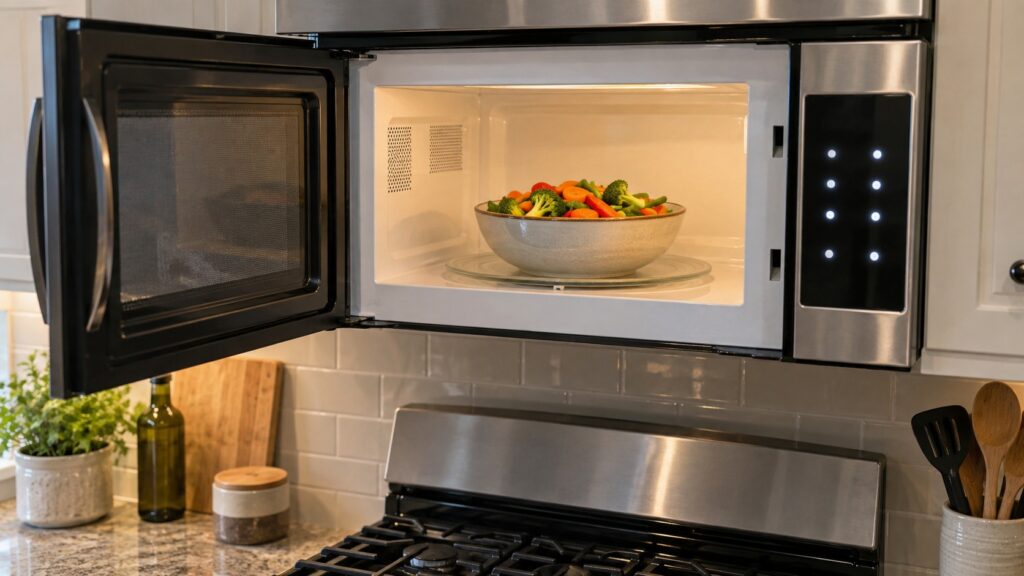
Maytag microwave sensor cooking lets the microwave decide when the food is done instead of you setting a time. On the over-the-range MMV5227JZ, our guides describe Sensor Cooking as a sensor that detects the steam coming off the food and adjusts the cooking time on its own. It suits vegetables, potatoes and a plate of leftovers. The tips below help you get steady results from it, and your owner’s manual remains the authority on which button to press for which food.
What does Sensor Cooking do on a Maytag microwave?
As food heats, it gives off steam. A sensor in the microwave notices that steam and uses it to judge how far along the food is, then sets the cooking time itself. That is the idea behind Sensor Cooking, and our guide on how a Maytag over-the-range microwave works says that Sensor Cooking measures steam to set the time. The model page for the MMV5227JZ lists Sensor Cooking as its feature, and our models-compared guide lists it as the step up from the plain MMV1175JW.
The practical point is simple: you are trusting steam as the signal, so anything that changes how steam escapes, such as a sealed lid, can change the result. We do not have a list of food categories or button names for the MMV5227JZ on this site, so use the manual for those details.
Which foods suit Sensor Cooking?
Our models-compared guide says Sensor Cooking suits people who cook vegetables, potatoes or a plate of leftovers and want the microwave to decide when it is done. Those foods give off steady steam as they heat, which is exactly what a steam sensor reads. For a food that is not on the list in your manual, a timed cook is the safer choice, because the sensor may not read it well.
Popcorn is a separate case. Maytag’s AccuPop works on a similar idea for popcorn, and our AccuPop guide explains it. Do not mix the two buttons up.
How do you get steady results?
- Use a microwave-safe dish and give the food room, so steam can leave it freely.
- Cover food only as your manual allows, since a tight lid can change how steam reaches the sensor.
- Do not open the door during a sensor cycle unless you must; the manual explains what happens if you do.
- Stir or turn the food when the cycle ends and check that it is hot all the way through before you eat it.
- Wipe the inside of the microwave after splatters; see the care section of your owner’s manual.
If a dish comes out cooler than you want, add a short timed cook rather than running the whole sensor cycle again. Over time you will learn how your microwave treats your favorite dishes.
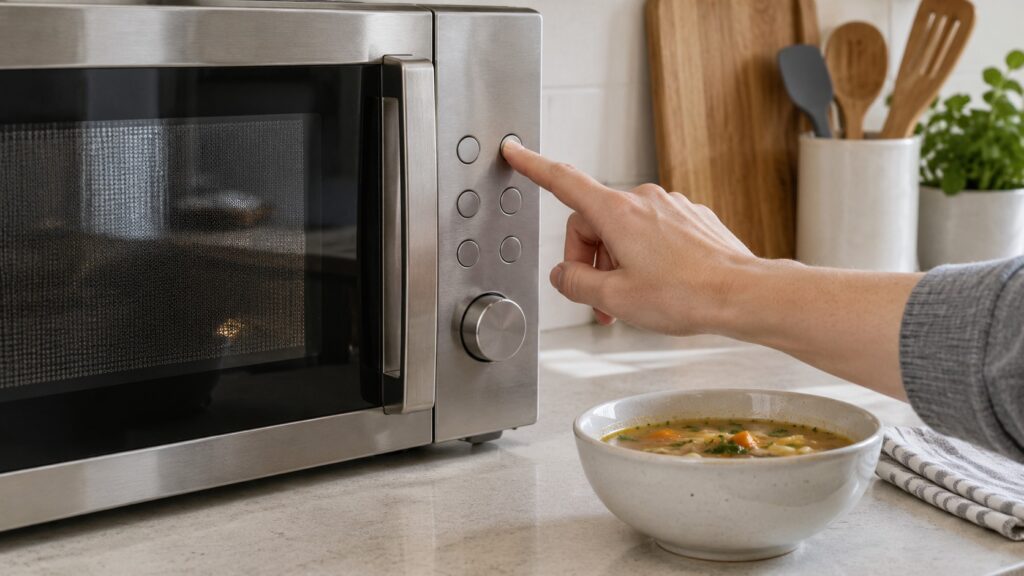
How is sensor cooking different from a timed cook?
With a timed cook, you pick the number and the microwave runs for exactly that long, whatever the food is doing. With Sensor Cooking, the food sets the pace. A larger portion gives off steam for longer, so the cycle runs longer, and a small portion finishes sooner without you changing anything. That is why it works well for leftovers, where the amount on the plate changes from day to day. A timed cook is still the better tool for melting butter, warming a drink or any job where steam is not a useful signal.
What are the safety points for an over-the-range microwave?
Because the MMV5227JZ hangs over the range, it is higher than a countertop unit. A hot dish lifted from a high microwave is a real burn risk, as our models-compared guide points out. Use oven mitts, pull the dish toward you slowly and let steam escape away from your face when you open a cover. Never run the microwave empty.
Do not open the cabinet of the microwave, even if it is unplugged. The high-voltage section can store a charge, and our guide says that no-heat problems must be tested by a technician with the right tools. If the microwave sparks, smells of burning or smokes, stop it, leave the door closed and switch off the breaker at the panel while standing on a dry floor.
What if Sensor Cooking does not seem to work?
Check the simple things first. Is the dish microwave-safe, is the door closing fully and is the interior clean? If the cycle stops early or runs too long on food that normally works, try a timed cook to see whether the microwave heats at all. If it does not heat, that is a repair job, and our Maytag microwave runs but won’t heat guide explains the usual causes. If the display shows an E-series or F-series code, see Maytag microwave F1E4 and E-series codes. Note the code and give it to your technician.
For daily care of the cavity, the vent grille and the filters, see how to clean and maintain a Maytag microwave.
When should you call a technician?
Call if the microwave does not heat, if a code appears that does not clear, if the door does not close or latch properly, or if you see sparks. The sensor, the control and the high-voltage parts are inside the cabinet and are a technician’s work. Our Maytag microwave repair page explains how a visit works.