

F9E1 and drn are two Maytag drain codes that describe the same plumbing at two different moments. drn appears at the start of a cycle: the washer found water already standing in the tub when it expected an empty one. F9E1 appears at the end of a drain step: the pump ran, but the tub did not empty within the time the control allows. Same filter, same hose, same pump, opposite halves of the cycle, and the difference is what tells you whether to expect a blockage you can reach or a pump that has lost its push.
What does F9E1 mean on a Maytag washer?
It means the drain step ran past its limit. The control opens the pump, watches the pressure sensor for the level to fall, and expects the tub to be empty within a set window. When the level is still above the threshold at the end of that window, the washer stops and posts the maytag washer f9e1 code rather than moving on to a spin with water still in the drum.
Notice what that definition does not say. It does not say the pump failed. A pump running at full speed into a hose blocked by a sock produces exactly the same reading as a pump whose impeller has broken off the shaft. The code is a stopwatch, not a diagnosis, and that is why the same three suspects appear against it every time.
What does the drn code mean, and how is it different?
The drn code is the washer looking into the tub before it starts and finding water that should not be there. Nothing was pumped yet, nothing timed out; the machine simply refuses to add more water on top of what is already standing.
That timing is the useful part. Water sitting in the tub between cycles means the last drain never finished, or that water is flowing back in from the standpipe. A drain hose pushed too far down a standpipe siphons the tub empty and then lets the line refill it; a hose looped too low does the same thing more slowly. Neither is a pump fault, and neither is visible while the machine is running.
So the pair reads like this: drn is what you find in the morning, F9E1 is what happens in the afternoon. If you only ever see drn, look at the hose run first. If you only ever see F9E1, look at the filter and the pump first.
Why does one clogged filter show up as two different codes?
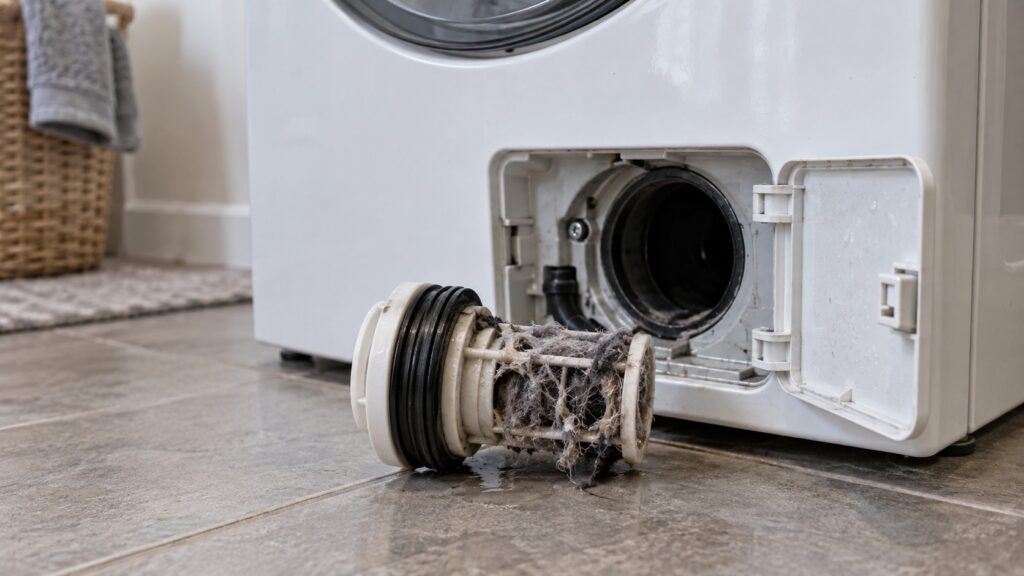
Because a partial blockage and a total one behave differently. Lint, coins and hair build a mat across the pump filter gradually. Early on, water still leaves the tub, just slowly, and the only symptom is a drain step that creeps past its window: F9E1. Later the mat closes completely, the tub never empties at the end of a load, and the next cycle opens on standing water: drn.
That progression is worth knowing because it tells you how long the problem has been building. A washer that has started showing F9E1 occasionally is giving you warning. The same washer showing drn every morning has been ignored for a while, and by then the pump has been running against a blocked outlet for weeks, which is how a cleaning job turns into a parts job.
What can I check before calling anyone?
- Look behind the machine at the hose. Check for a kink where the washer was pushed back, a loop resting on the floor, and how far the hose end sits inside the standpipe. It should enter a few inches, not a foot.
- Open the drain pump filter. On front-load Maytag machines it is behind a small access door at the bottom front. Have a shallow pan and towels ready, because the tub will be full. The step-by-step is in our guide to cleaning the Maytag washer drain pump filter.
- Listen during the drain step. A pump that hums without moving water sounds different from one that is silent, and different again from one that rattles because something hard is riding the impeller.
- Count the loads. If the code only follows bedding, towels or a rug, the problem may be the load rather than the plumbing.
Stop before opening the cabinet. The pump housing sits in the water circuit next to line voltage connections, and on a machine with water still in the tub, a removed hose empties onto the floor with no way to stop it.
Could it be F8E1 instead, a fill problem rather than a drain one?
It could, and owners mix them up constantly because both feel like the machine is stuck on one step for a long time. F8E1 is long fill: the washer is not getting water fast enough, and the causes are inlet valves, screens at the hose connections, a closed faucet or low pressure in the house. Nothing in that list touches the pump or the filter.
Tell them apart by looking at the tub. If it is filling slowly or not at all, that is a supply story. If it has water it cannot get rid of, that is a drain story. Puddles on the floor are a third case entirely and belong with our guide to Maytag washer leaks.
When is the drain pump actually failing?
When the filter comes out clean, the hose run is straight, and the code still arrives. That combination is the clearest evidence you can gather at home, and it is worth gathering before anyone is called, because it turns a diagnostic visit into a repair visit. Two more signals point the same way: a pump that is audibly weak when it used to be loud, and a code that appears on every cycle rather than on heavy loads only.
A pressure sensor or its hose can also lie about the level, which makes a perfectly good pump look slow. That one needs a meter, not a flashlight, and it is the reason a drain code that survives a clean filter is not worth guessing at.
We are an independent repair company, not a factory service arm, and drain work is usually a short visit with a small part. Pricing starts from a diagnostic visit and we confirm the estimate before any work begins. Book Maytag washer repair or schedule a visit with the code, your model number and whether the tub was full or empty when it appeared.