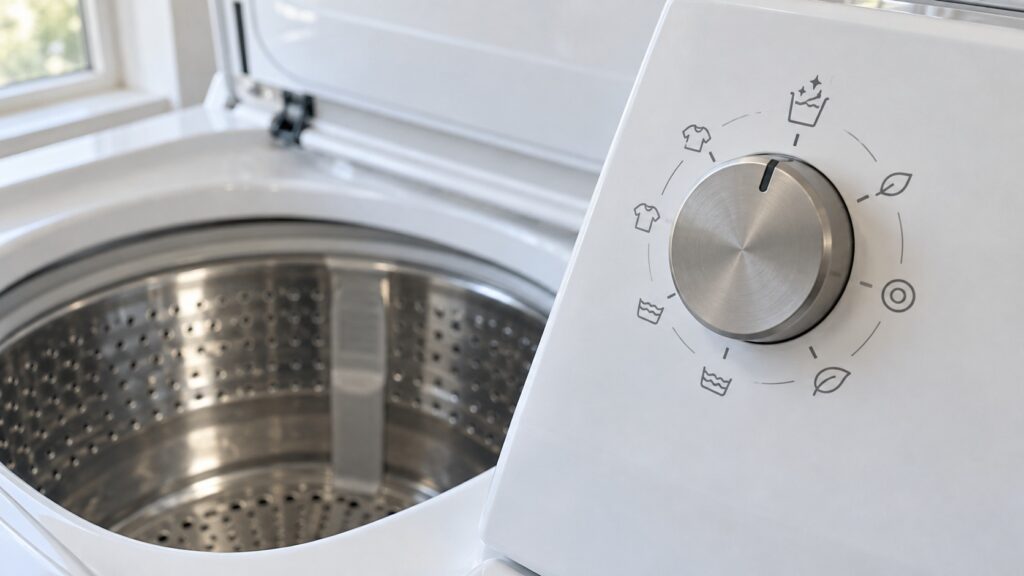
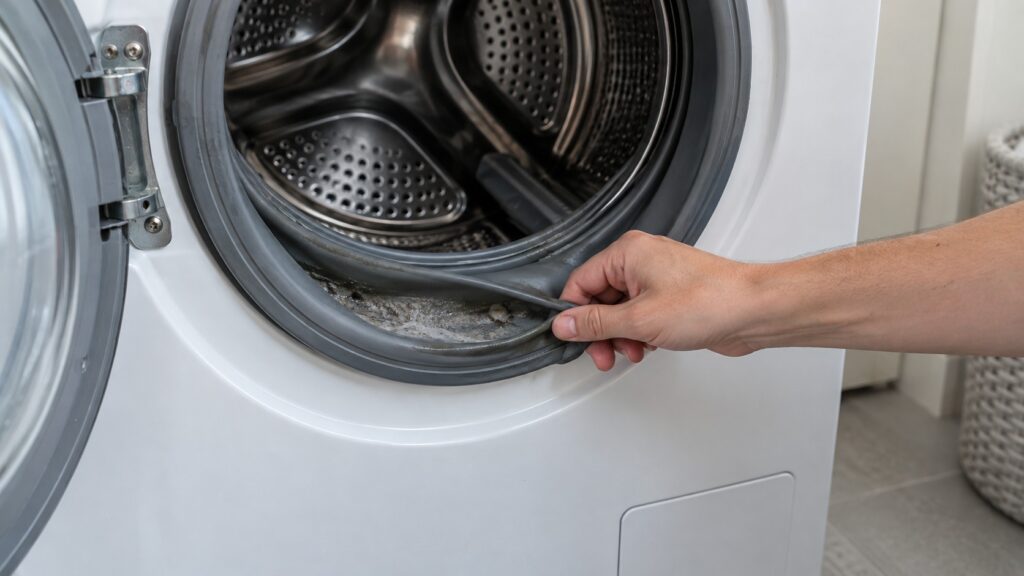
The position on the dial labeled Clean Washer is the one setting that does not wash laundry. The Maytag washer self clean cycle runs the machine empty at the highest water level and the hottest water the inlet will give it, holds that water far longer than a normal wash, and spins hard between fills to scour the parts a wash cycle never reaches: the underside of the impeller or agitator, the outer tub behind the basket, the drain path, and on front-load machines the folds of the door boot. It cleans the washer. That is the whole idea, and it is why the machine objects when it finds clothes inside.
What does the self clean setting on the dial actually do?
It changes three things at once. It fills to a level a laundry cycle never uses, because the point is to cover surfaces that normally sit above the water line. It calls for the hottest supply available rather than a temperature chosen for fabric. And it extends the soak, so whatever cleaner you added has time to work on a film that took months to build.
Between those fills it spins, and that part matters more than owners expect. Spinning throws water up the sides of the basket and forces it through the perforations into the space between the basket and the outer tub, which is where residue actually accumulates. A cycle that only soaked would leave that gap untouched.
Top-load models such as the MVW5035MW, MVW6200KW, MVW6230HW, MVW6500MW and MVW7232HW reach this setting through the cycle dial; front-load panels usually give it a dedicated pad. The routine underneath is the same. Which ordinary cycles do what is a separate subject, covered in our Maytag washer cycle settings guide.
Why does rL appear during the Clean Washer cycle?
Because the washer weighed the drum and found something in it. The load-sensing step that normally decides how much water a wash needs is repurposed here as a check: the cycle is supposed to start from an empty basket, so any mass at all is reported as rL, laundry detected.
Take the items out and start the cycle again from the beginning. Do not try to resume it, because the fill sequence has already been abandoned. This is not a fault and no part is involved.
Two things trigger rL when the drum looks empty. A single heavy item left behind, a bath mat or a pair of jeans against the far wall of the basket, is easy to miss through a top-load opening. And a machine that did not fully drain the last load is carrying water weight, which reads as mass to the same sensor. If that is the case, read the drain codes first in our guide to Maytag washer F9E1 and drn.
Why does Sud show up when I use regular detergent?
Because the cycle is designed around a cleaner that does not foam, and ordinary detergent does. Sud means the control saw more foam than the tub can handle, so it stopped and started a rinse to knock it down, which is why a clean cycle sometimes takes far longer than the time it announced.
Foam is not a cosmetic problem here. A layer of suds cushions the water at the pump inlet, so the pump moves air instead of water, the drain step drags, and a drain code can appear behind the suds code with nothing wrong in the plumbing at all. Use the tablet or cleaner the machine asks for, or nothing, and never pour in extra detergent on the theory that the washer is dirty.
On models with an auto-dose cartridge, empty the dispenser before the cycle. A cartridge that keeps dosing through a clean run is the surest way to see Sud on an empty machine.
How often should I run it?
Once a month is the usual rhythm, and the honest answer is that it depends on how the machine is used. High-efficiency machines use little water, cold washes are common, and liquid detergent plus fabric softener leaves a film that heat and volume are needed to remove. A household washing in cold water with softener every load needs the cycle more often than one washing hot with powder.
The signals to watch for are a musty smell when the door has been shut, gray flecks on dark fabrics, and a ring of residue on the door boot or under the lid rim. Any of those mean the cycle is overdue rather than optional.
What does the cycle not clean?
Everything the water does not sit against. The rim of a top-load lid, the underside of the dispenser lid, the removable detergent drawer and its housing, and on front-load machines the deep fold at the bottom of the door boot where water pools and stays. That fold holds the smell that owners blame the machine for, and it has to be wiped by hand; our guide to cleaning the Maytag washer door boot shows what to look for.
Leaving the door or lid open between loads does more for the smell than any cycle, because the film only grows on surfaces that stay wet. A washer that dries out between uses stays clean far longer.
When does a smell survive the cycle?
When something is holding water that the cycle never drains. A drain hose looped low keeps standing water in the line; a partly blocked pump filter keeps a reservoir behind it; a boot that has torn on the underside traps water in the tear. None of these show a code, and all three come back within days of a clean run.
That is the point to have someone look rather than repeat the cycle. Stop before opening the cabinet or the pump housing yourself: those parts sit in the water circuit beside line voltage connections.
We are an independent repair company, not a factory service arm, and we will say when a smell is a habit rather than a repair. Pricing starts from a diagnostic visit and we confirm the estimate before any work begins. If it is the machine, book Maytag washer repair or schedule a visit with your model number to hand.