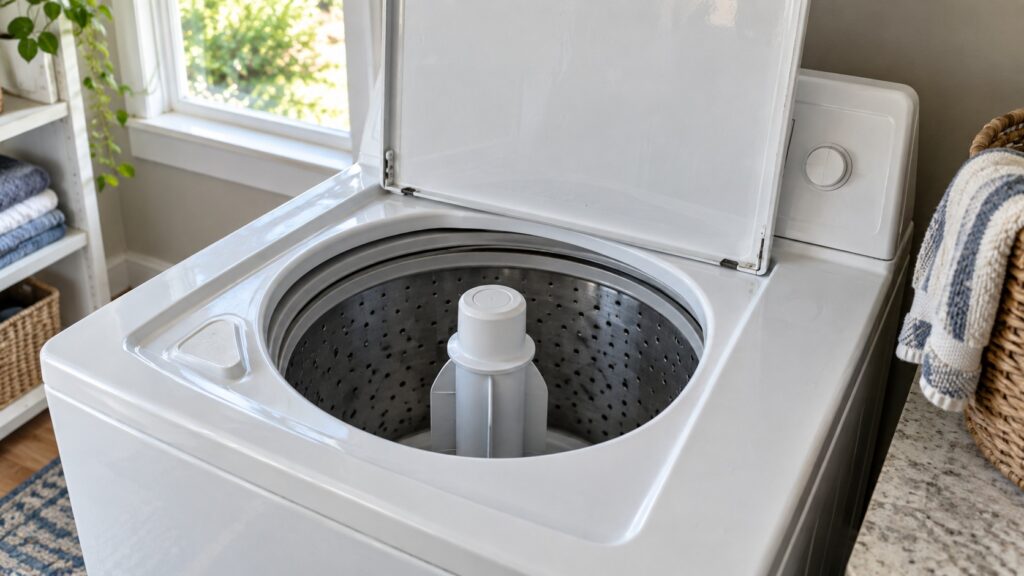
The Maytag washer agitator vs impeller question splits top-load machines into two genuinely different appliances that look almost identical from the outside. One has a tall post in the middle of the drum that twists clothes through the water; the other has a low disc that moves the water and lets the water move the clothes. Everything people argue about — cleaning, gentleness, capacity, cycle length — follows from that one difference.
What each one actually does to the laundry
An agitator grips the load and twists it back and forth, so the cleaning comes from fabric rubbing against the post and against itself. That is effective on ground-in dirt and it is why agitator machines still have a following among people who wash genuinely dirty clothes.
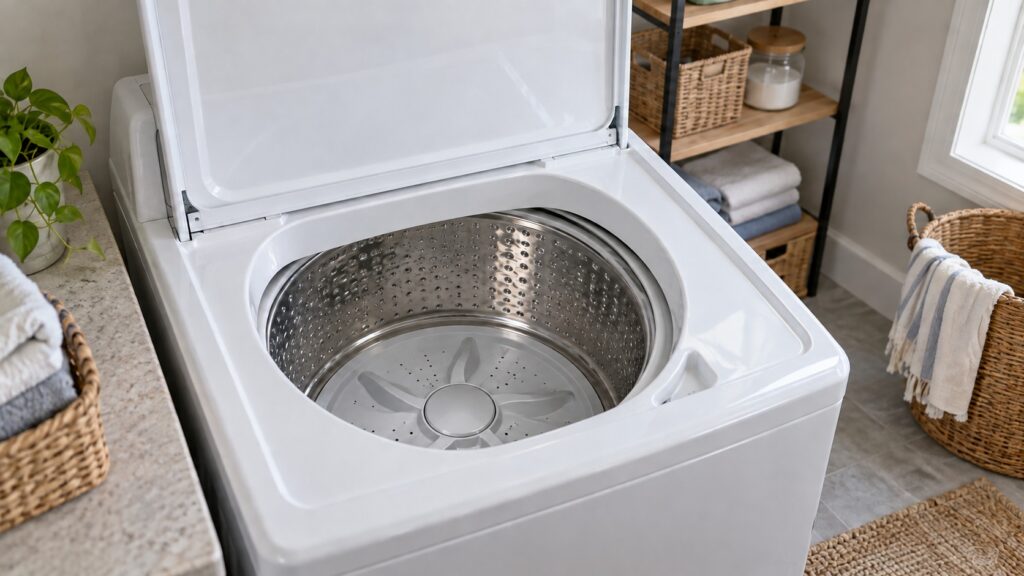
An impeller spins the water into a current and lets that current tumble the load. The action is gentler, it uses less water because the drum does not need to be filled as deeply, and it is easier on delicate fabrics. The trade is time: moving clothes through water takes longer than dragging them past a post.
Cycle length is the surprise
Nearly everyone moving from an agitator to an impeller reports that the new machine takes far longer, and it does. That is not a fault and it is not particular to any brand — less water and gentler action need more time to reach the same result. A normal cycle that ran fifty minutes on an old agitator machine can run well over an hour on an impeller one.
Practically, it means the quick-wash program becomes the weeknight cycle. If the household needs a load done in forty minutes reliably, that is a genuine argument for an agitator, and it is worth saying rather than dismissing.
Where the impeller is clearly better
- Bulky items. A comforter, a sleeping bag or a mattress pad needs room to move, and a central post takes that room.
- Fabric care. Less mechanical action means less wear, and fewer of the small tears and pilled edges that agitators cause over years.
- Water use. Meaningfully lower per load, which matters both on a bill and on a septic system.
- Loading. A flat drum floor is simply easier to load and unload than one with a post in it.
Where the agitator is clearly better
Heavily soiled work clothes, sports kit that has been in mud, anything where the dirt is in the fibers rather than on them. The mechanical action does something water movement alone does not, and no amount of program selection closes that gap entirely.
Agitator machines are also generally cheaper to buy and mechanically simpler, which some households value for its own sake. And the shorter cycle is a real advantage in a house where the washer is a bottleneck rather than a background appliance.
The mistake that undoes either choice
Overloading. Clothes clean by moving, and a drum packed to the top has nothing moving — the load rotates as a single mass and the middle never sees fresh water. An impeller machine shows this faster because it relies on the load tumbling freely, but an agitator machine suffers too.
The rule that works on both: load to about three quarters, and be able to fit a flat hand between the top of the load and the drum. Our top load against front load guide covers the wider format question, and the drain pump filter guide covers the maintenance either format needs.
Water level, and the complaint that follows every upgrade
Both modern designs use far less water than machines from twenty years ago, and on an impeller machine you will often lift the lid mid-cycle and see clothes that are damp rather than swimming. That is correct operation, and it is the single most common reason people conclude a new machine is not cleaning: it does not look like washing.
Some machines offer a deep-fill or extra-water option. Used occasionally on a genuinely dirty load it is useful; used by default it wastes water without improving the result, because the detergent is then diluted below the concentration it was designed to work at. Trust the machine for ordinary loads and reserve the option for the ones that deserve it.
Fabric wear over years, not loads
The gentleness argument is hard to see in a single wash and obvious over a few years. Agitator machines produce more pilling on knits, more wear at seams and more of the small tears that appear on items with straps, drawstrings or hooks. None of it happens in one cycle; all of it accumulates.
If the laundry is mostly cottons and work clothes, that wear is a reasonable price for the cleaning. If it is mostly knitwear, activewear and things bought to last, the impeller earns its longer cycle. This is the question worth asking rather than the cleaning comparison everyone starts with.
What does not differ
Reliability does not follow the choice. The parts that decide how long a washer lasts — bearings, suspension, the drain pump, the door or lid switch — are the same families in both designs. Neither is inherently more repairable, and neither wears out sooner because of the drive arrangement.
Spin speed is worth more attention than either. Every gallon removed mechanically is a gallon the dryer does not have to boil off, so a faster spin shortens every dryer cycle for the life of the pair. Between two machines of the same format, that is usually the better tiebreaker.
Before replacing the one you have
A washer that will not drain, will not spin, or has started leaking is very often a pump, a hose, a lid switch or a suspension component rather than an appliance at its end — all ordinary parts. See our repair or replace guide.
We are an independent repair company, not a dealer, so we have nothing to sell you on the buying side. Maytag washer repair starts with a diagnostic visit, we confirm the estimate before any work begins, and you can schedule a visit online.