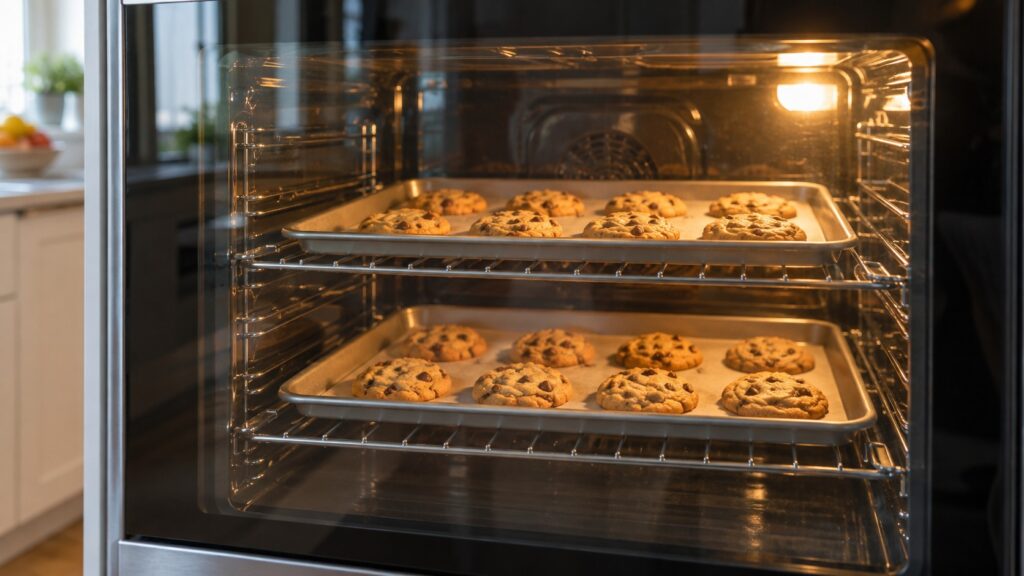
Maytag EvenAir is the convection arrangement in the oven — a fan and, on many models, a third heating element around it, moving heated air so every rack gets the same treatment. When baking turns uneven on an oven that has this, the instinct is to blame the convection. It is usually right that something has changed, and usually wrong about what.
What convection actually changes
A conventional oven heats from elements and lets the air move by itself, which gives a warm top, a cooler bottom and a hot zone at the back. Convection adds a fan that keeps the air circulating, so those differences flatten out and every rack sees close to the same temperature. That is the entire benefit, and it is why convection matters most when baking several trays at once.
It also means convection cooks faster at the same dial setting, because moving air transfers heat better than still air. Many recipes therefore need a lower setting or a shorter time on convection — and a cook who has switched to convection without adjusting will report exactly the symptom of “everything overbrowns”, which is not a fault.
Level is the cause people never check
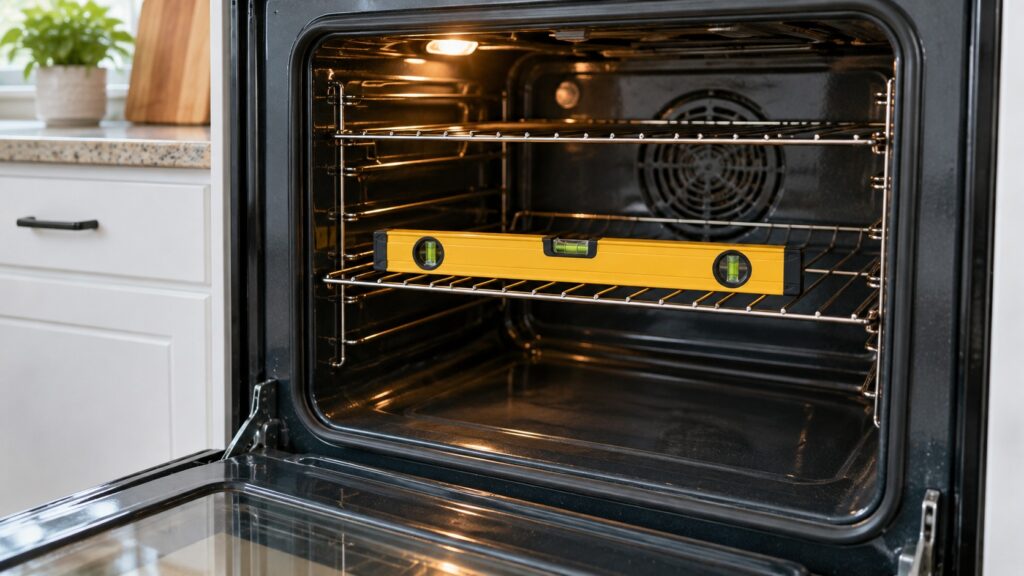
An oven cavity out of level pools batter at one edge and browns one side of a tray, and no amount of air movement fixes it. This is the first thing to rule out and the cheapest: put a spirit level on the middle rack, front to back and side to side.
Check it again after any flooring work nearby and after the range has been loaded. Our range maintenance guide covers the feet, and a range that rocks on one corner is a leveling problem before it is anything else.
Then the door
A door that no longer seals lets heat escape continuously, and it rarely leaks evenly — a sagging hinge or a compressed gasket on one side produces exactly the asymmetric browning people attribute to the fan. Test with a strip of paper: close the door on it and pull at several points around the opening. It should drag everywhere.
A door that has started to drop rather than glide shut is hinge springs, which is an ordinary part. A gasket that has hardened or flattened in one place is a gasket. Both are inexpensive, and both produce months of baking frustration before anyone connects the two.
Racks, trays and the things that block air
- Foil on a rack or across the floor blocks circulation completely and reflects heat where it should not go. This is the most common self-inflicted convection problem.
- Trays that fill the rack leave no path for air around them. Leave a gap at the sides and the back.
- Too many racks at once stops the air moving between them, even with a fan.
- Dark or warped pans bake differently from light flat ones, and warping is usually blamed on the oven.
When it is the fan
Open the door mid-bake and listen. The fan should be audible and steady. Silence with the oven otherwise working means the fan or its motor has stopped, and the oven has quietly become a conventional one — which bakes fine but not evenly, and slower than the recipe expects.
A fan that rattles or scrapes is a blade that has come loose or is touching its housing, and that is worth stopping for. Our page on oven features covers which modes use the fan, since some programs run it and others do not — a fan that seems intermittent may simply be following the program.
Convection needs the recipe adjusted, and that is not a fault
Moving air transfers heat faster than still air, so the same dial setting cooks harder on convection. Most guidance is to drop the temperature by around 25°F, or to keep the temperature and shorten the time — but not both at once, which is where people go wrong and then report an oven that burns everything.
Some models do that adjustment for you automatically when convection is selected, and some leave it to the cook. Which yours does is worth establishing before concluding anything about the fan, because an oven that silently subtracts 25°F and a cook who also subtracts 25°F together produce a tray that never browns. Check the manual once and you never wonder again.
Which position on the dial uses the fan
Not every program on a convection oven runs the fan, and the labeling rarely makes that obvious. A conventional bake setting usually does not; a convection bake and a convection roast do, and they use the elements differently from each other. Some models also have a proofing or dehydrate mode that runs the fan with almost no heat.
The practical consequence is that a fan which seems to work sometimes and not others is very often following the program rather than failing intermittently. Before diagnosing a fan, run a program you know uses it and listen with the door shut — many models stop the fan when the door opens, which makes listening through an open door useless.
Calibration drift looks like an airflow problem
If everything comes out pale and slow rather than uneven, the issue is temperature and not circulation. Ovens drift a few degrees over years as sensors age, and because it happens gradually people adapt without noticing until a familiar recipe stops working.
An oven thermometer on the middle rack settles it in one preheat, and most ovens allow the calibration to be adjusted — see our calibration guide. That is an adjustment rather than a repair.
When to call
A silent or noisy convection fan, an element that glows unevenly or not at all, a door that will not seal after the hinges have been looked at, or an oven that cannot hold its set point — those are parts. So is a cavity that has started to overheat, which frequently follows a self-clean cycle.
We are an independent repair company, not a factory service arm. Pricing starts from a diagnostic visit and we confirm the estimate before any work begins. Maytag oven repair covers fans, elements, sensors and doors, and you can schedule a visit online.