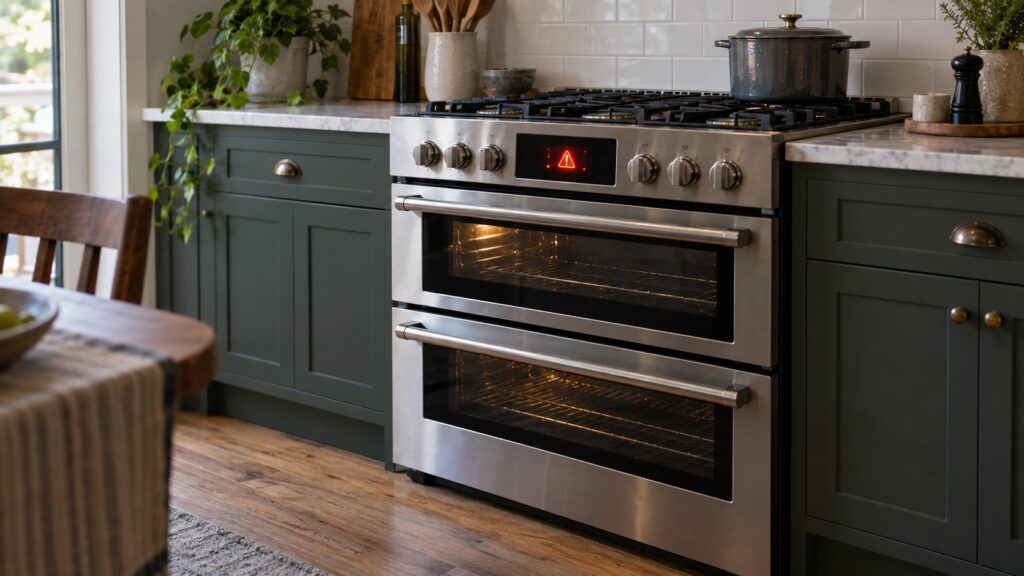
Maytag range f9-1 f9-2 gemini double oven codes both point to a door-latch failure — Maytag’s two-cavity range design — with F9-1 identifying the upper-cavity latch and F9-2 identifying the lower-cavity latch. Both codes name the same category of fault: the latch motor, the latch switch, or the wiring between them isn’t confirming a properly locked door for whichever cavity the code refers to.
What is a Gemini double oven, and why does that matter for these codes?
Maytag’s Gemini double oven range packs two separate, independently controlled oven cavities into a single range — a smaller upper cavity and a larger lower cavity, each with its own door, its own latch mechanism, and its own heating system, rather than one large single-cavity oven. Because each cavity operates independently, each one also needs its own latch confirmation system, particularly for self-clean cycles where the door needs to be reliably locked before the cavity heats to self-clean temperatures. F9-1 and F9-2 exist as separate codes specifically because Maytag needed a way to tell you which of the two independent cavities has the latch problem, rather than one generic code covering both.
What’s actually different between F9-1 and F9-2?
The fault itself — a latch that isn’t confirming a properly locked door — is identical in kind between the two codes; the only difference is which cavity it’s happening on. F9-1 means the upper cavity’s latch mechanism has the problem, and F9-2 means the lower cavity’s latch mechanism does. That distinction matters practically because on a Gemini double oven, the upper and lower cavity latch assemblies are separate physical components, so a technician diagnosing F9-1 will be looking at different hardware than one diagnosing F9-2, even though the diagnostic approach — checking the latch motor, the switch, and the wiring — is the same for both.
What should you check yourself before calling for service?
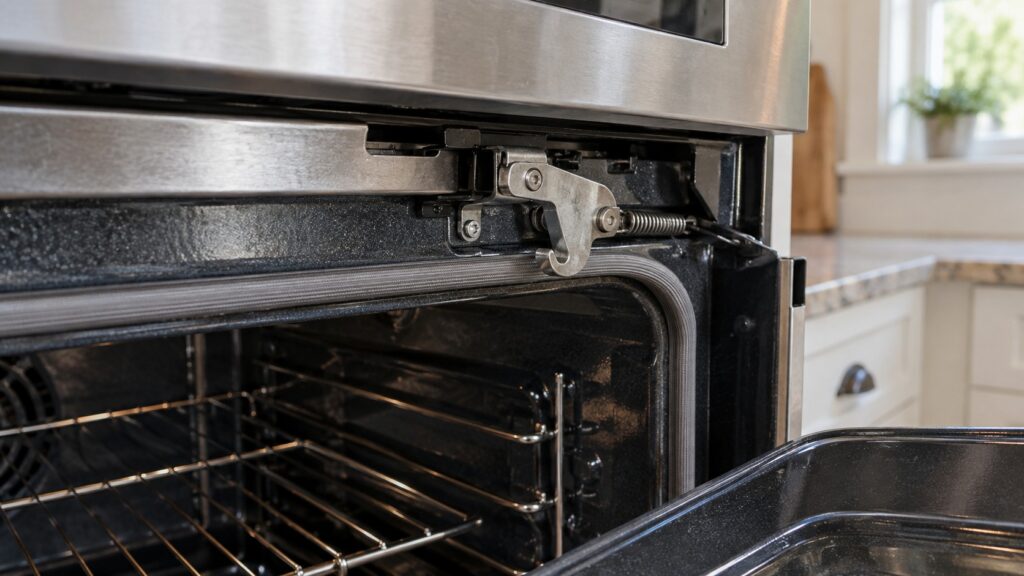
Start with the simplest possibility: confirm the door for the affected cavity is actually closing fully and seating flush in its frame, since a door that’s slightly misaligned — from a bent hinge, a warped gasket, or something caught in the door seal — can prevent the latch from fully engaging even if the latch mechanism itself is working correctly. If the door closes and seats properly and the code still appears, that points more toward the latch motor, the switch that confirms the latch position, or the wiring connecting them to the control board. Unplugging the range for a few minutes and restarting it can clear a code that was latched from a one-time condition rather than one that’s actively recurring; if the code returns as soon as you try to use that cavity again, the fault is live.
Why does the latch need to confirm a locked door in the first place?
The latch confirmation system exists mainly for self-clean cycle safety — the oven needs to know the door is genuinely locked before running a cycle hot enough to be dangerous if the door opened unexpectedly. Beyond self-clean specifically, a reliable latch confirmation also matters for normal cooking on some designs, since the control system uses that same signal as part of confirming the cavity is ready to operate as expected. Either way, F9-1 and F9-2 are the oven telling you it can’t verify the door is safely secured for that cavity, which is why the response is to display a fault code and typically prevent that cavity’s self-clean cycle from running, rather than to attempt to proceed anyway. Our guide on Maytag range self-clean mode covers the broader self-clean cycle and door-lock behavior these codes relate to.
Can a loose wiring connection really cause a latch fault code?
Yes — the wiring harness connecting the latch motor and switch to the control board runs through a part of the range that experiences heat cycling every time either oven cavity is used, and connectors in that environment can loosen or their contacts can degrade gradually over years of normal use. A connection issue produces the identical code to an actual failed latch motor or switch from the control board’s perspective, since the board is only reading whether it received the expected confirmation signal, not diagnosing why that signal didn’t arrive. This is exactly why checking accessible wiring and connections, where you’re comfortable doing so, is worth doing before assuming a full latch assembly replacement is needed.
If one cavity shows F9-1 or F9-2, is the other cavity safe to keep using?
Generally, yes. Because each cavity on a Gemini double oven has its own independent latch motor, switch, and wiring run, a fault on one cavity’s latch hardware does not indicate anything about the other cavity’s condition or safety. If F9-1 appears on the upper cavity, the lower cavity can typically keep running its own cooking and self-clean cycles as normal, and vice versa for F9-2 on the upper cavity. The one exception worth watching for is a wiring or connector issue that traces back to a shared point on the control board rather than to either cavity’s dedicated harness — uncommon, but worth mentioning to a technician if both cavities start showing unrelated symptoms around the same time.
Is a Gemini double oven with a latch fault worth repairing?
Generally, yes — a latch mechanism failure on one cavity of a Gemini double oven is a contained, moderately priced repair that doesn’t affect the other cavity or the range’s other systems, and it’s very much worth fixing on a range that’s otherwise working well. The calculation changes only if the range has a broader pattern of issues beyond this one latch fault, or if the unit is old enough that parts for the two-cavity design — which is less common than single-cavity ranges — are becoming harder to source. Our Maytag range repair or replace guide covers that broader decision if F9-1 or F9-2 turns out to be one of several issues on an aging unit, and our range cleaning and maintenance guide is worth reading alongside this one to keep both cavities’ door seals and latch areas in good condition going forward.
If your Maytag Gemini double oven is showing F9-1 or F9-2 and checking the door alignment didn’t resolve it, our technicians can test the latch motor, switch, and wiring on the affected cavity directly — schedule a visit and we’ll confirm what needs replacing before ordering a part.