Maytag dishwasher flashing lights are a code. On machines without a digital display, the control reports faults by blinking a cycle light in a counted pattern, and the pattern is read as two numbers: a group of flashes, a pause, then a second group. A 6-1 pattern is no inlet water. An 8-1 pattern is a heating element failure. A 9-1 pattern is the diverter valve. Nothing about the blinking is random, and it is not the machine asking to be reset. It is the same information a newer Maytag dishwasher puts on a screen as an F-E code, delivered by the only output the panel has.
What do flashing lights on a Maytag dishwasher mean?
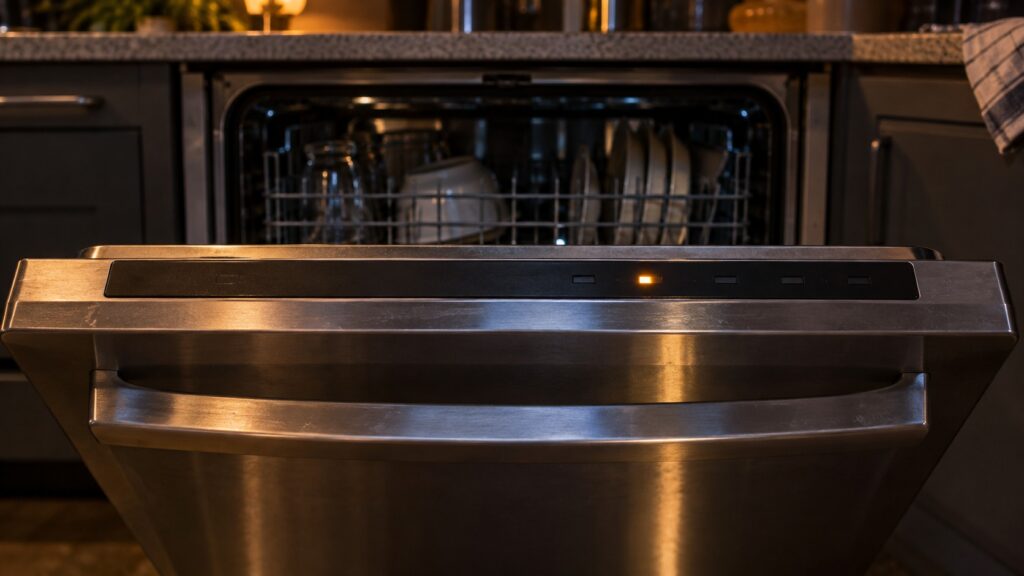
They mean the control has a fault to report and no screen to print it on. Maytag calls these legacy flash patterns, and they belong to dishwashers whose panel is a row of cycle lights rather than a display window. When the machine stops and one light blinks steadily while the others sit dark, it is counting out a fault number at you.
This is why maytag dishwasher flashing lights feel so much worse than they are. A blinking panel looks like an electrical emergency, and owners cut power to it repeatedly, which clears the display and loses the information. The pattern is worth reading before anything is reset, because it is the only thing that narrows seven possible faults down to one.
How do I count the flash pattern?
Stand in front of the machine with the door closed and watch one full repetition without touching anything. You are looking for a rhythm: several quick flashes, a distinct pause, then a second group of flashes, then a longer pause before the whole thing repeats.
- Count the first group. That is the first number. A group of eight flashes is an 8.
- Count the second group after the short pause. That is the second number, and it is usually small: one, four or five.
- Watch it twice. Long groups are easy to miscount, and 8-1 against 9-1 sends you to a different part entirely.
- Write it down before resetting. A power cycle clears the pattern, and if the fault is intermittent you may wait days for it to come back.
If the panel beeps along with the blinking, the beeps often follow the same count, which gives you a second way to check a number you are unsure about.
Does my dishwasher use flashes or an F-E code?
Look at the panel rather than the model number. If the controls are a row of labeled cycle lights with no window, you are in the flash-pattern family. If there is a display that can print characters, your machine uses the F-E codes instead, and a fault arrives as F6E4 or F9E1 rather than as a count of blinks.
The two schemes describe similar territory but do not translate one to one, so never read a flash count as if it were an F-E number. A 9-1 pattern is the diverter valve; the F9E1 code on a display machine is a drain timeout. Same digits, different faults, different parts.
What can I clear myself, and what points at a part?
Three of the seven patterns have an owner-level cause worth checking first.
1-1, the door latch. The machine is not being told the door is shut. Check that the latch strike on the tub lines up, that a rack or a tall item is not holding the door a fraction open, and that the door closes with the usual click. A door that has dropped on its hinges does this, and so does a loaded top rack pushing forward. Our guide to Maytag dishwasher door latch problems covers the alignment.
6-1, no inlet water. Start outside the machine: the shutoff valve under the sink, which gets closed during unrelated plumbing work and never reopened, and the supply line where it is kinked behind the cabinet. Only after that does the inlet valve become the suspect.
10-5, a stuck key. Wipe the panel and watch for a pad that lights or beeps on its own. A key held down by grease or moisture reads as a press the control cannot ignore.
The other four are parts. A heating element, a thermistor, a circulation pump and a diverter valve are all inside the machine, under the tub or behind the panel, and all four sit in the same space as the water circuit and the line voltage wiring. Do not go looking for them with the door open and the breaker on.
Why does a pattern come back after a reset?
Because a reset clears the report, not the condition. The control rechecks at the same point in the next cycle and finds the same thing, which is why a pattern that returns at the same stage every time is more informative than one that appears at random.
Use that timing. A fault raised during fill is a water problem, whatever the count says. One raised during the main wash points at the circulation pump or the diverter. One raised toward the end of the cycle, when the dishes come out wet and cold, points at the element or the sensor. A pattern that never repeats twice in the same place usually means a connection rather than a component.
A dishwasher that is not draining is a separate story from all of the above, and it is covered in our guide to a Maytag dishwasher that will not drain. Filters are the one piece of routine maintenance that prevents several of these: see how to clean your Maytag dishwasher filter.
When does a flashing pattern mean a technician?
Book a visit for 8-1, 8-4, 8-5 and 9-1 once you have the count, because all four are internal parts and none of them have an owner-level fix. Book one for 1-1 or 6-1 when the door lines up and closes properly, or when the supply valve is open and the line is clear, and the pattern still runs.
Bring the count with you to the call. A technician told that the lights are flashing has to reproduce the fault before anything else; a technician told it is an 8-5 arrives with the right part on the truck.
We are an independent repair company, not a factory service arm, and we will tell you when an older dishwasher is not worth the part. Pricing starts from a diagnostic visit and we confirm the estimate before any work begins. Book Maytag dishwasher repair or schedule a visit, and have the flash count and your model number ready.