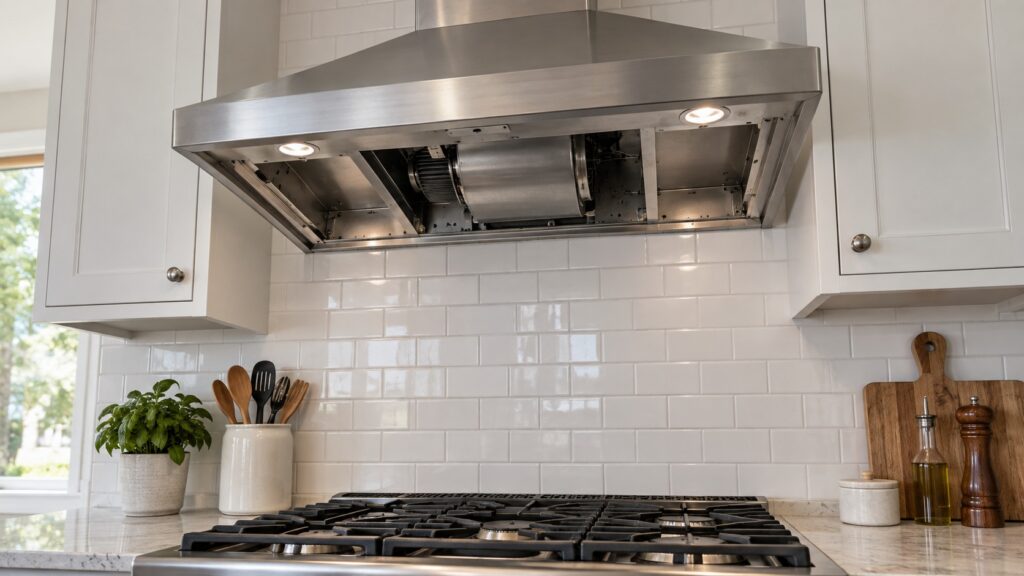
Grease filters get cleaned because you can see them. The blower wheel and the maytag range hood duct behind it get ignored for years, and that is where hood performance actually goes. A hood that sounds as loud as ever but no longer clears steam from the cooktop is almost always telling you about the parts nobody looks at.
Why airflow dies without the noise changing
The motor turns the blower wheel at the same speed whatever happens downstream. What changes is how much air that wheel can actually move. Grease builds on the blades as a hard varnish, the blade profile disappears, and a wheel designed to scoop air becomes a spinning cylinder that mostly stirs it. The sound is identical. The airflow is a fraction of what it was.
The same applies to the duct. A run coated in grease has a smaller effective diameter, and the exterior damper flap is often glued shut by the same deposit. If your hood used to clear a pan of searing steak and now does not, start there rather than at the motor.
Cleaning the filters properly
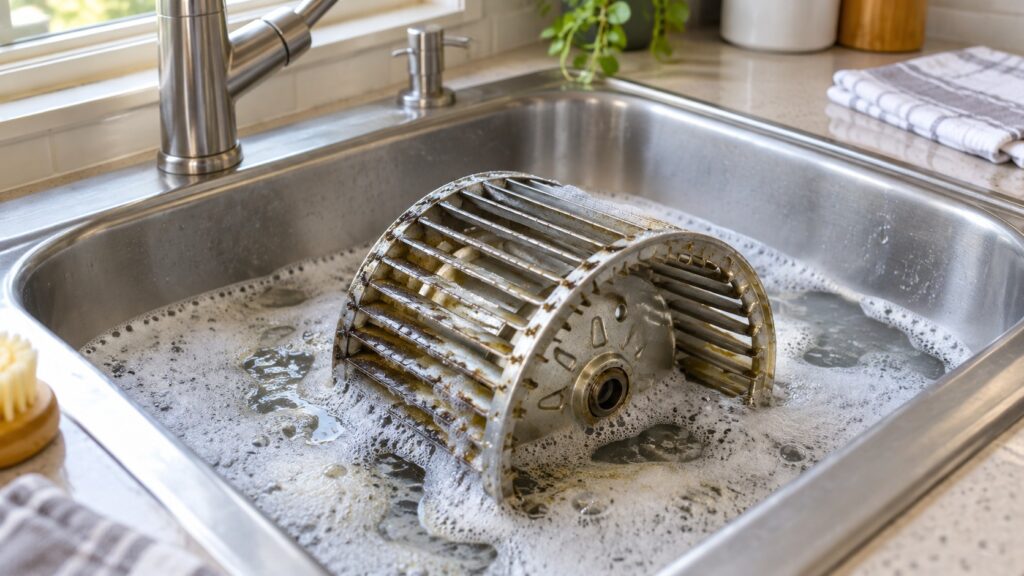
Baffle and mesh filters both come out by hand, usually by pushing back and dropping the leading edge. Soak them in the hottest water your sink will give, with a degreasing dish liquid and a scoop of baking soda. Twenty minutes of soaking does more than twenty minutes of scrubbing.
Mesh filters can go in the dishwasher, but repeated cycles dull aluminum to a chalky gray — cosmetic, not functional, though worth knowing before you do it to a visible hood. Let filters dry completely before refitting, because trapped water runs back down into the blower housing. Our grease filter guide covers the detail.
Reaching the blower wheel
With the breaker off and the filters out, the blower assembly is usually visible in the hood cavity, held by a few screws or a wing nut on the wheel hub. On many models the whole assembly drops out as a unit once the wiring connector is released.
- Photograph it before you take anything apart. Blower wheels go back one way around and it is not always obvious.
- Soak the wheel, do not attack it. Hot water and degreaser, then a soft brush between the blades. Solvents can attack the plastic on some wheels.
- Do not bend the blades. A deformed blade puts the wheel out of balance and you will hear it forever after.
- Wipe the housing too, and the fan scroll around the wheel. Deposits there narrow the outlet.
- Leave the motor dry. Nothing wet near the windings or the bearings.
The duct run
Ideally the duct is rigid metal, as short and straight as the layout allows, and it terminates outdoors — not in the attic, not in a soffit. Flexible foil duct on a range hood is a poor choice for the same reason it is on a dryer: the ridges collect grease, and grease in a duct is a fire path.
Once a year, look at what you can reach. Open the exterior hood or wall cap and check the damper flap swings freely, that it is not painted shut, and that nothing has nested inside — birds and wasps both like a warm, sheltered vent. A blocked termination makes every other part of the system look faulty.
If the hood is recirculating rather than ducted, the equivalent maintenance is the charcoal filter, which does not wash. It saturates and must be replaced. Our ducted against recirculating guide explains which one you have and what each can realistically do.
Small things that make a large difference
Turn the hood on before you start cooking, not when smoke appears — the rising column of hot air needs to be captured, and a hood that starts late is chasing it. Run it for several minutes after you finish, so the duct clears rather than sitting full of greasy air that then condenses.
Use the back burners for anything that spatters. Hood capture is far better at the back of the cooktop than at the front edge, which is why the same hood seems to work well for some cooking and badly for other cooking in the same kitchen.
Where the grease comes from, and why it accelerates
Every pan of frying oil sends fine droplets upward. The filters catch most of it, the rest condenses on whatever it touches first once the air slows down — which is the blower housing and the first few feet of duct. Once a thin film exists, new deposits stick to it far more readily than to clean metal, so the buildup is not linear. A hood that looked fine at year three can be badly restricted by year five.
That is the argument for putting the blower on a schedule rather than waiting for a symptom. Twice a year in a kitchen that fries regularly, once a year otherwise, and the job stays a twenty-minute soak instead of an afternoon with a scraper.
What maintenance will not fix
If the fan does not run at all, runs only on one speed, hums without turning, or the light works while the blower does not, that is electrical rather than dirt — a switch, a control board, a capacitor or the motor itself. A seized motor also smells hot, and that one should be turned off at the breaker and left alone.
Grinding or rattling that persists after a thorough clean usually means bearings or a wheel that has lost balance. Our fan and light troubleshooting guide separates those cases.
When to call
Call when the blower will not run or runs on one speed only, when noise persists after cleaning, when the duct run needs rework inside a wall or ceiling, or when a hood over a gas cooktop is no longer clearing combustion products properly. That last one is a safety matter rather than a convenience one.
We are an independent repair company and not a factory service arm. Pricing starts from a diagnostic visit and we confirm the estimate before any work begins. Maytag range hood repair covers motors, switches, controls and lighting, and you can schedule a visit online.